Category Archives: social

LavaCon 2012 Recap

Having returned from LavaCon Conference on Content Strategies and Digital Media, I feel much more confident within the field of technical communication. I have a list of colleagues I need to connect with after the conference and reconnect with others I saw too!

It is always a pleasure to meet up with conference attendees and this was the second time attending LavaCon. I have met most of my colleagues from previous STC Summits and it’s awesome that I get to see them twice a year.
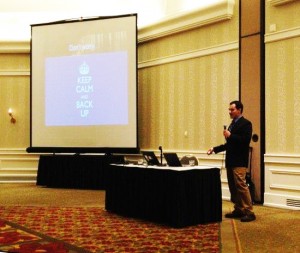
Keep Calm and Back Up

Keep Calm and Back Up Slide – Photo by David Caruso

At this conference, I presented during the lightning talk session along with Kit Brown-Hoekstra, Brenda Huettner, and David Caruso. We each presented on a variety of inspirational topics about our field. Usually during a lightning talk, we each speak for 10 minutes with 20 slides that auto-advance every 30 seconds. We had enough time in our session to add a “ninja talk,” which follows the same format, except the presenter does not have access to the slides in advance to prepare for their talk. David Caruso was the lucky presenter to speak about “The Art of the Lightning Talk,” which Rachel Houghton recorded the presentation.

In addition to the conference, I enjoyed Adobe Day as well as the pre-conference workshop session on change management. Many thanks go out to my colleagues who I met at LavaCon. I greatly appreciate the help and advice they provided while socializing with them between sessions.

I also want to thank Jack Molisani, the Executive Director of the LavaCon Conference for opening up new opportunities in the technical communication field. The experience at LavaCon is rather unique due to his awesome conference hotel location choice; amazing food options and entertainment; and fantastic selection of professionals he invites to present during this conference.

Among my adventures in Portland, here are some numbers

  • Stayed in Portland for 5 days
  • Ate 3 Voodoo Doughnuts (yum!)
  • Visited Powell’s City of Books, which contain over 1 million volumes
  • Spent $10 to enjoy the Internet access for about 5 hours on Southwest Airlines (you have no idea how awesome internet is on a plane).
  • Walked over 10 miles in one day

Be sure to read coverage of LavaCon on TechWhirl Online Magazine for Tech Writers, follow #LavaCon as well as @LavaCon, and attend LavaCon next year!
What is Klout and why should you join?

Ever wonder who you influence on social media these days? This service called Klout analyzes your interactions on social media and shows you how influential you are to your friends online. Based on your social interactions, Klout assigns you a Klout score. The higher it is, the more popular you are among your social connections. In addition, your Klout score can determine the kinds of rewards, dubbed Klout Perks, you might receive in terms of giveaways, discounts, and special deals from company sponsors.

Klout shows you the insight on the topics that you influence the most among your social network of friends. What this service does is track the social response to your posts, such as how many comments, replies, shares, retweets, likes, etc, from an array of social networking accounts. Klout explains it further in detail.

Based off what Klout finds out about connected networks, the service designates a Klout Score and lists topics they are influential on. In addition, Klout allows you to track topics that your friends influence you in as well as allow you the option to give away points, known as “K+”, to those who recently influence you in a certain topic. It is a simple version of a referral system in which you can learn who you directly influence.

Networks

Klout analyzes your social media activity on Facebook, Twitter, Google+, LinkedIn, YouTube, FourSquare, Instagram, Tumblr, Blogger, WordPress.com, Last.fm, and Flickr. Based on what networks you connect to, Klout can find out how influential you are to your friends. In the near future, users may be able to connect and analyze social influences with Quora, Yelp, Posterous, Livefyre, Disqus, Bit.ly, and BranchOut. So far, it looks promising.

Klout Perks

Do you like to get rewarded for using social networks? Sponsors have teamed up with Klout to offer specials, discounts, and giveaways. These can range from free business cards, sample products, discounted services, or specials only available for Klout users with certain Klout scores. While this may be a great way to reward users, it is another avenue of direct marketing. Klout’s approach to provide a channel for advertisers to promote their products and services to tech-savvy and social media fans is brilliant and somewhat convoluted. What is great about this system is that it’s not “in your face” advertisement, which some social media users dislike with a passion.

Are Social Media Connections Safe?

In order for Klout to analyze your social interactions, it needs access to your social media accounts. This access is currently done via OAuth, which is a service that you can link up your Facebook or Twitter account with Klout. This system is also how users would log into Klout, much the same way Pintrest, BranchOut, and some news sites allow you to use your login name for Twitter or Facebook to log in instead of creating a brand new account from scratch. (Even WriteTechie uses OAuth via WordPress to allow readers to post comments.)

First, you have to allow Klout to connect to your Twitter, Facebook, LinkedIn, and Google+ accounts in order for the service to begin analyzing your social media activity. Not to worry, Klout won’t spy on your information; it just reads it for tracking purposes and displays statistics about your usage. The nice part about using OAuth is that you can revoke access if you believe there is suspicious activity.

Why join?

What is there to lose? There may be more to gain by learning what you are influential about and what others might think about you. In essence, it’s a social network of social networks. While Klout may not offer specific statistics, like Google Analytics, it’s a great way to measure oneself and others on social media.

Add me as an influencer on Klout: http://klout.com/RogerRenteria
Friend me on Facebook: http://fb.com/roger.renteria
Follow me on Twitter: http://twitter.com/RogerRenteria
Add me to your circles on Google+: http://profiles.google.com/roger.renteria
Connect with me on LinkedIn: http://linkedin.com/in/rrenteria

Twitter experience at the STC 2012 Summit

I was delighted to see Twitter use increase year after year at the STC Summits. At the 56th Annual STC Summit in Atlanta, GA, I co-presented an educational session that talked about this social network. My colleagues who were on Twitter at the time were the earliest adopters of the service; I never imagined how useful it would be three years later at the STC 2012 Summit in Chicago, IL.

Pre-Conference Networking

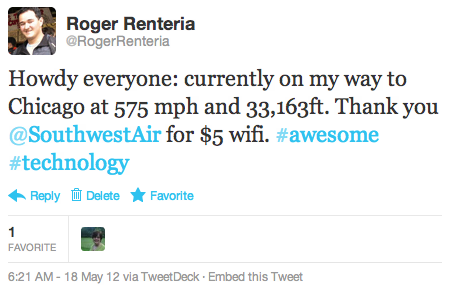
Before the 2012 Summit started, I tweeted my excitement about attending the STC 2012 Summit in Chicago to meet new and familiar professionals. In addition, I tweeted about my adventure heading into Chicago, which entailed flying across the Plains States from Albuquerque to Chicago. For me, it was my first experience using the internet on an airliner.

Twitter on the plane

Twitter on the plane

Session Tweets

Special thanks go to the coordinators of the STC Summit for arranging internet access at the previous summits. It is a HUGE benefit value to have internet access at the conference hotel to update Twitter and allow readers to follow the #stc12 hash tag.

Throughout the conference, I was able to bring my laptop and see updates from conference attendees who were in other sessions. In some cases, I wish I could be in two places at one time because I kept reading great tweets about Tristan Bishop’s session while attending Jenna Moore’s talk, which was extremely good too.

I also love to read what people have on their minds while at the same session. It was great to engage in conversation during the session. At the same time, I tried to limit the amount of tweets that quoted the presenter during the session. Reflecting from previous conference tweets, I wanted to improve the quality of my posts instead of being “first” to tweet about the presentation. I felt that during the 2011 Summit, I rushed to post and I didn’t get as much out of the presentation because I was distracted with Twitter.

To me, it was a matter of post quality over quantity and I strived to post the best content possible.

Finding People / Providing Information

At the beginning of the conference, I saw Sara Baca’s tweet about her issues logging into the wireless internet. I sent her a direct message with the login details for the WiFi connection. I was able to share that information and she in turn shared that info for others at the summit.

Another example was trying to locate people at the conference. I went to Twitter to find a couple of classmates from my Alma Mater, New Mexico Tech. Kai Weber said he found one of the Techies (nickname for students who attend Tech) and he would try to connect me with the student. What was great is that Kai responded to my message. He happened to monitor the #stc12 feed at the time and surreptitiously found my post.

STC 2012 tweet asking about New Mexico Tech students

STC 2012 tweet asking about New Mexico Tech students

My last example was to find Menno de Jong, Editor of the publication, Technical Communication. I posted to the #stc12 feed asking if anyone saw him. Sara Baca told me he was a neighbor in the hotel but she had not seen him recently. Then @stc_org told me that he would be at the Honors Banquet rehearsal Tuesday at 3:30. When I stopped by the rehearsal, Menno was there. Twitter proved to be a useful resource to find and locate people easily. I believe Menno doesn’t carry his phone or have a Twitter account, so it was possible to locate him through my techcomm Twitter contacts who were attending the conference.

Before I finish, Ben Woelk posted an entry discussing the statistics regarding Twitter Use at #stc12. It is his second year writing about how we use Twitter at the STC Summit. You can check out his post on Twitter at STC 2011 and 2010 for comparison.